If you only had one free tool to diagnose why a site isn’t ranking, it should be Google Search Console. Using Google Search Console for SEO isn’t optional anymore — it’s the closest thing you’ll get to a direct line into how Google actually sees your website, what it’s indexing, and where it’s losing patience with you.
Google Search Console for SEO helps website owners understand how their pages appear in Google Search and identify opportunities to improve organic traffic.
2026 has made this tool more important, not less. With AI Overviews and AI Mode now shaping a huge share of search results, Search Console has quietly become the only place most site owners can see whether their content is even showing up in AI-generated answers. That changes what a “complete” audit looks like this year.
This checklist walks through every section worth auditing, in the order that actually matters, so you’re not just staring at graphs without a plan.
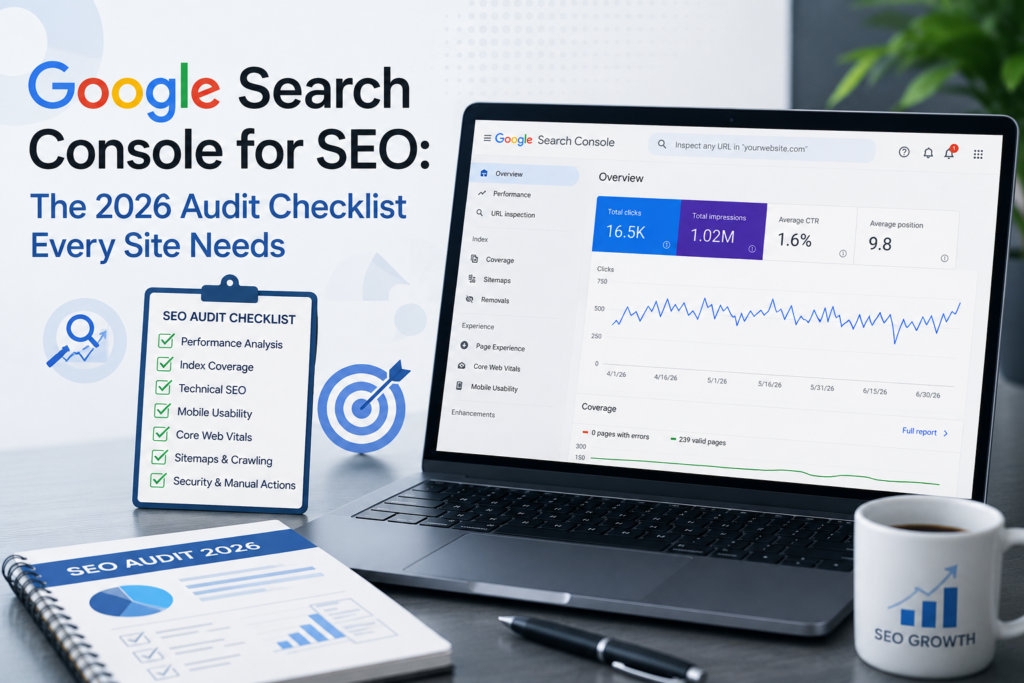
Google Search Console For SEO: Why It Matters in 2026
Search has split into two experiences: traditional blue links and generative AI answers. Google’s own announcement of new Search Generative AI performance reports confirms this shift — site owners can now see impressions inside AI Overviews and AI Mode directly in Search Console, separate from standard organic data.<cite index=”2-1″>On June 3, Google announced new Search Generative AI performance reports in Search Console, giving site owners dedicated visibility into how their pages perform inside AI features</cite>
Google Search Console for SEO helps you identify indexing problems, search performance issues, and pages that may need improvement.
At the same time, Google rolled out a setting that lets site owners control whether their content is used to ground AI answers at all, along with new insight reports showing which pages appear in AI responses and in which countries.<cite index=”6-1″>With this new toggle in Search Console, website owners can decide if they want their site to appear in and help ground responses in our generative AI Search features</cite>
That means a 2026 audit needs to check indexing, technical health, and content quality — plus a new layer: AI visibility.
Using Google Search Console for SEO can help you identify pages that need better titles, descriptions, content, or technical improvements.
Step 1: Start With Indexing, Not Rankings
Before worrying about position tracking confirm Google can actually find and index your pages.
Open the Pages report under Indexing.
Review every “Excluded” reason, not the total count
Cross-check excluded URLs against your sitemap to catch pages that should be indexed but aren’t.
Common exclusion causes worth flagging are perceived value, duplicate content, thin internal linking or Google simply deciding not to prioritize crawling a page. If a page looks fine to you but isn’t indexed the issue is usually one of those four, not a bug.
If you fix an issue use Validate Fix. Request indexing individually. But treat this as a nudge, not a guarantee. Reprocessing depends on relevance, content quality and competition regardless of how times you resubmit a URL.
Step 2: Audit the Performance Report for Search Intent Gaps
The Performance report is where most audits stop too early — people check clicks and impressions and move on. Instead:
-
- Filter by query and sort by impressions with low CTR. These are pages ranking but not earning clicks — usually a title tag or meta description problem, not a ranking problem.
-
- Compare branded vs. non-branded queries. Branded traffic tends to convert better but non-branded queries reveal where you can actually grow.
-
- Use the weekly/monthly view toggle to separate real trends from daily noise before making any content decisions.
Google has also added an AI-assisted filtering tool in this report that lets you describe the analysis you want in plain language, which speeds up this step considerably if it’s available on your property.
Step 3: Check Core Web Vitals and Mobile Usability
The way a website performs technically is still very important for how it can be crawled and for the experience of the user. When we look at the Contentful Paint or Core Web Vitals we want the score to be 2.5 seconds or less. This is what we consider good. If the score is between 2.5 and 4 seconds then it needs to be improved.. If the score is more than 4 seconds then it is not good at all.
For the Interaction to Next Paint or Core Web Vitals we want the score to be 200 milliseconds or less. This is what we think is good. If the score is between 200 and 500 milliseconds then it needs to be improved.. If the score is more than 500 milliseconds then it is not good. For the Cumulative Layout Shift or Core Web Vitals we want the score to be 0.1 or less. This is what we think is good. If the score is between 0.1 and 0.25 then it needs to be improved.. If the score is more than 0.25 then it is not good at all.
We should get the Core Web Vitals report and group the URLs that are not doing well by the template they use of trying to fix them one by one. This is because a template that is not working well can affect a lot of pages at the time. So if we fix the template then all the pages that use it will be fixed at the time. This will make things a lot easier, for us.
Step 4: Review Structured Data and Search Appearance
Support for data is always changing and it is easy to have old code without even realizing it.
Look at the Enhancements section to find any data errors.
Make sure you are not using types that are no longer supported. Google has been slowly removing things like FAQ results and some practice-problem markup from search results.
Focus on schema types that are still being used: Article, Product, HowTo and Breadcrumb are more likely to stay useful, than less common formats.
Step 5: Check Your AI Search Visibility
This is the newest and most overlooked part of a 2026 audit.
-
- Look for the AI Search performance reports if they’ve rolled out to your property yet — they’re launching gradually.
-
- Decide deliberately whether you want your content grounding AI Overviews and AI Mode answers, using the new opt-in/opt-out control, rather than leaving the default unexamined.
-
- Track pages that get AI impressions without clicks separately from your normal CTR analysis — that traffic still does brand-awareness work even without a visit.
Common Mistakes to Avoid
Treating “Excluded” as one bucket. Each exclusion reason needs a different fix.
Chasing rankings without checking indexing first. A page can’t rank if it isn’t properly indexed.
Ignoring branded query filters. Without separating branded and non-branded queries, you’ll misread which content is actually driving new demand.
Fixing Core Web Vitals page-by-page. Template-level fixes save far more time.
Forgetting mobile usability entirely, since most Search Console reports default to combined data that can hide mobile-only problems.
Google Search Console SEO Audit Checklist (Quick Reference)
-
- Review Indexing report and resolve exclusion reasons by category
-
- Audit Performance report for high-impression, low-CTR pages
-
- Separate branded vs. non-branded query performance
-
- Check Core Web Vitals by template, not by individual URL
-
- Confirm mobile usability has no unresolved issues
-
- Audit structured data for deprecated or broken markup
-
- Review AI Search performance reports if available
-
- Set your AI grounding preference deliberately
-
- Cross-check sitemap coverage against indexed pages
-
- Document findings and prioritize fixes by page value, not page count
FAQ
How often should I run a Search Console SEO audit? It is an idea to do a quick check every month and a complete audit every three months. This schedule works well for websites. It is also an idea to check more often right after a major update or when moving a website.
Does Search Console have an effect on rankings? No. It is a tool that helps find problems and shows data. Fixing the issues it shows can help improve rankings. The tool itself does not change where a website appears in search results.
Is Search Console by itself for a complete SEO audit? Not completely. It is very useful, for checking how a website is indexed its technical condition and the search queries it gets.. It is better to use a crawler tool to check the whole website for technical issues and a backlink tool to check the strength of the links pointing to the site.
A regular Google Search Console for SEO audit can help you catch problems early and keep your website performing well in search results.
Conclusion
A proper Google Search Console for SEO audit in 2026 isn’t just about clicking through old reports out of habit. Indexing, Core Web Vitals, structured data, and now AI visibility all deserve a place in the process, checked in that order, so technical issues don’t hide behind rankings problems that were never really about rankings at all. Run through this checklist quarterly, document what you find, and fix issues by template and category rather than one URL at a time — that’s where most of the time savings come from.
On-Page SEO Notes for publishing
We should link to a post on Core Web Vitals optimization or on-page SEO fundamentals. This is an internal linking opportunity for the Core Web Vitals optimization post.
We can also use Googles announcement on AI Search controls in Search Console as an external authoritative reference. The website for this is https://blog.google/products-and-platforms/products/search/new-controls-website-owners/. It is about Googles AI Search controls in Search Console.
Regularly reviewing Google Search Console for SEO can help you keep your website technically healthy and improve its visibility in Google Search.
For images we can use a screenshot of the Search Console Indexing report. The alt text for this image should be “Google Search Console for SEO indexing report showing excluded pages”.
We can also use a Core Web Vitals table graphic. The alt text for this image should be “Core Web Vitals thresholds for LCP, INP and CLS in 2026”.
Another option is an AI Search performance report screenshot. The alt text for this image should be “Google Search Console AI Overviews performance report”.
We should make a video that shows how to use the Performance report filter workflow. This can be a screen-recorded walkthrough of the Performance report filter workflow for the Core Web Vitals optimization post.
For schema we should use Article schema for the post. We should also use FAQPage schema for the FAQ section. This will help with the Core Web Vitals optimization and, on-page SEO fundamentals.